The 2018 Global Conference on Air Pollution and Health, organized by the World Health Organization (WHO) and the UN Climate Change secretariat, highlighted the urgent need to address air quality. WHO Director-General Tedros Adhanom Ghebreyesus, Ph.D., called air pollution “a silent public health emergency,” a sentiment we strongly support.
In this article, we will examine air quality in the United States, covering pollution sources, environmental and health effects, and monitoring practices. Additionally, we will delve into the specifics of particulate matter (PM), its health risks, and the importance of reducing indoor levels.
What is air pollution?
Air pollution refers to the presence of harmful solid, liquid, or gaseous substances in the air, both indoors and outdoors, at concentrations exceeding recommended or typical levels. The Clean Air Act of 1970, a major U.S. law, identifies six key air pollutants:
- Particulate matter (PM): Tiny solid and liquid particles suspended in the air. These can originate directly from sources like construction sites or unpaved roads, or be formed through chemical reactions involving pollutants like sulfur dioxides emitted from power plants and gas- and diesel-powered automobiles.
- Ground-level ozone (O3): A gas formed when nitrogen oxides and volatile organic compounds react, often in sunlight. While ozone in the upper atmosphere protects us from UV radiation, ground-level ozone is a harmful pollutant that can trigger a variety of health problems.
- Carbon monoxide (CO): A colorless, odorless gas produced by incomplete combustion of fuels like gasoline or wood. Poor ventilation can lead to dangerous indoor accumulations.
- Sulfur dioxide (SO2): A pungent, toxic gas released primarily from burning sulfur-containing fuels, often from industrial sources and diesel engines.
- Nitrogen dioxide (NO2): A gas formed mainly from burning fuels in vehicles, power plants, and other equipment.
- Lead (Pb): A naturally occurring element, also emitted from some industrial processes, that can contaminate air, soil, and water.
Environmental consequences.
Air pollution has significant environmental consequences. Some key impacts include:
- Acid rain: Pollutants like nitric and sulfuric acids, often released from industrial processes and combustion, can mix with precipitation or dry particles, creating acid rain. This acidic precipitation damages ecosystems by acidifying water and soil, harming trees, crops, and even buildings.
- Haze: Fine particles in the air, largely from industrial emissions, power plants, and vehicles, reduce atmospheric clarity, creating haze. This reduces visibility and can impact scenic views.
- Climate change: Certain air pollutants contribute to climate change. For example, black carbon, a particulate pollutant from burning fuels, absorbs sunlight and transforms it into heat. This warms the atmosphere and accelerates the melting of glaciers, snow, and sea ice.
Threat to human health.
The World Health Organization reports that 99% of the global population breathes air exceeding recommended pollution limits, contributing to over 7 million premature deaths annually and impacting the health of billions more. Low- and middle-income countries are disproportionately affected due to higher levels of exposure.
Common health effects
- Short-term effects: Irritation of the eyes, nose, skin, and throat, as well as breathing difficulties and headaches.
- Long-term effects: Respiratory infections, stroke, heart disease, lung diseases (including COPD), and immunological disorders.
Susceptible groups include
- Infants, children, and teens
- Individuals with lung diseases such as asthma and COPD
- People with cardiovascular disease
- Current or former smokers
- Obese individuals
- People with low incomes
- Those living in highly polluted areas
Air quality measurement.
Air quality is measured and reported using a standardized system, although there isn’t a single “good air quality” metric. The U.S. Environmental Protection Agency (EPA) maintains a database of air quality data from thousands of monitoring stations across the country. This data is used to calculate the Air Quality Index (AQI), a color-coded system for reporting and forecasting daily air quality.
The EPA sets national air quality standards for six major pollutants: particulate matter, ground-level ozone, carbon monoxide, sulfur dioxide, nitrogen dioxide, and lead. An AQI is calculated for each of these pollutants.
Low levels of pollutants, posing little to no health risk
None
These are acceptable levels, but sensitive individuals may experience health effects
Unusually sensitive individuals should consider limiting prolonged outdoor exertion
Pollutant levels may cause health problems for sensitive groups like children, older adults, & people with heart or lung disease
Children, active adults, and people with respiratory disease, such as asthma, should limit prolonged outdoor exertion
Everyone may begin to experience health effects, with more profound effects for sensitive groups
Children, active adults, and people with respiratory disease, such as asthma, should avoid outdoor exertion; everyone else should limit prolonged outdoor exertion
Health risks are increased for all
Children, active adults, and people with respiratory disease, such as asthma, should avoid outdoor exertion; everyone else should limit outdoor exertion
Widespread health impacts are likely
Everyone should avoid all physical activity outdoors
Particulate matter: air’s tiny threat.
Particulate matter (PM), also known as particle pollution, refers to the mixture of tiny solid and liquid particles in the air. These particles are categorized by their diameter in micrometers (µm):
- PM10: Coarse particles, 10 µm or smaller.
- PM2.5: Fine particles, 2.5 µm or smaller.
- PM1.0: Ultrafine particles, 1 µm or smaller.
To give a sense of scale, a grain of fine beach sand is about 90 µm and a grain of salt is around 60 µm. The human eye can typically see particles between 10 µm and 40 µm. According to ASHRAE, nearly all (99.9%) airborne particles are smaller than PM1.0.
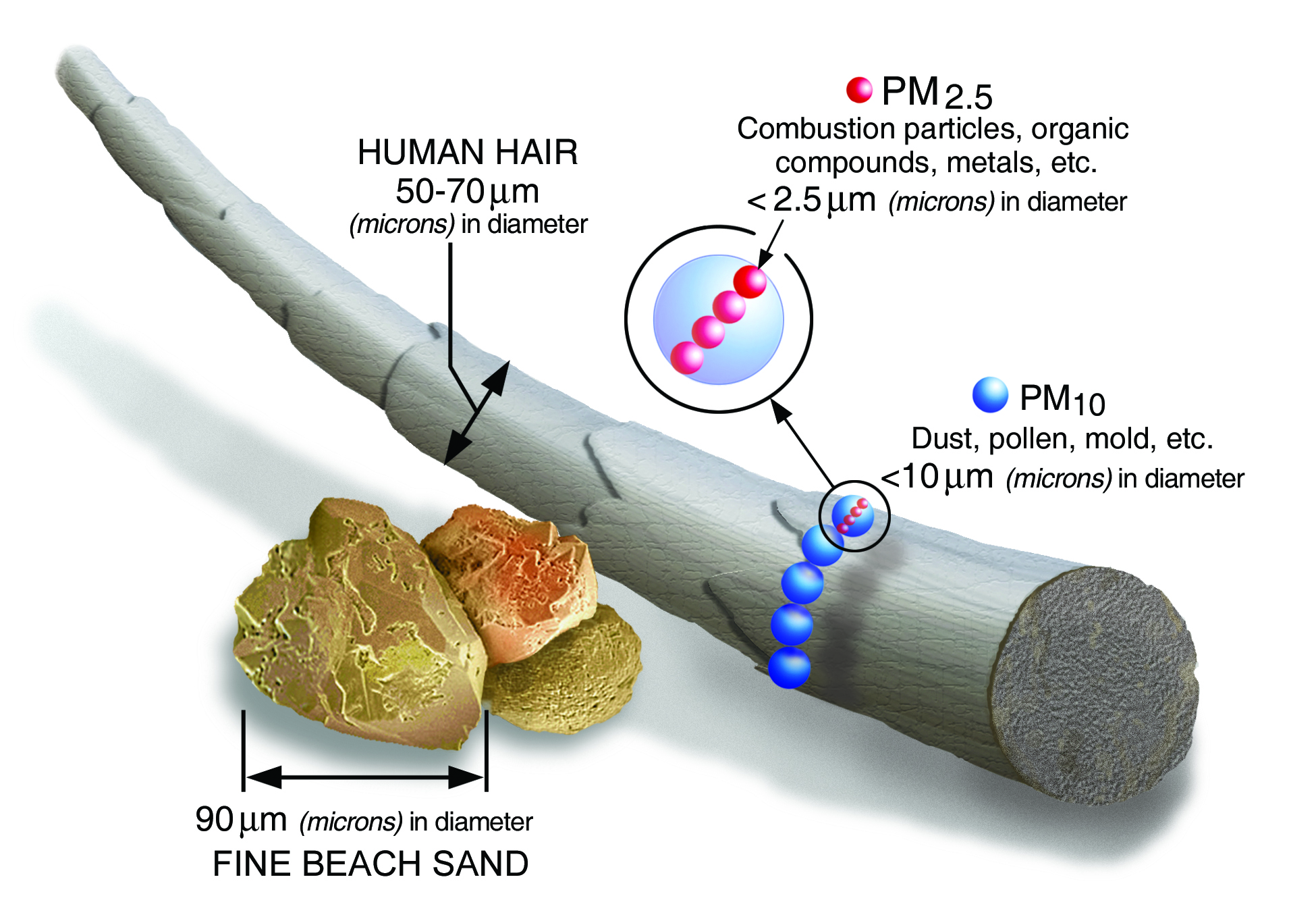
Particulate matter originates from two main sources: direct emissions, such as dust and debris from construction sites or unpaved roads, and indirect formation, particles formed through chemical reactions between gaseous pollutants, like soot from car exhaust or fireplaces.
Harmful effects of PM
Exposure to particulate matter has well-established negative health effects, both short-term and long-term. The EPA notes that inhaling PM can harm the heart and lungs. While any particle smaller than 10 µm can be detrimental, finer particles (PM2.5 and PM1.0) pose a greater risk as they can penetrate deeper into the lungs and even enter the bloodstream. Individuals with heart or lung conditions, children, and older adults are particularly vulnerable.
Reducing indoor PM is crucial.
Indoor air often contains higher concentrations of PM than outdoor air, and Americans, on average, spend approximately 90 percent of their time indoors. Exposure to these particles can have a substantial impact on our health, including irritation of the eyes, nose, throat, and lungs, worsening of heart and respiratory disease symptoms, and premature death for those with pre-existing conditions.
By minimizing indoor PM through strategies like source control, proper ventilation, and effective air cleaning, we can create healthier living and working environments, reducing the risk of these adverse health effects and improving overall quality of life.
Sources.
- World Health Organization. “Air Pollution.” Accessed February 14, 2025. https://www.who.int/
- United Nations Framework Convention on Climate Change. Accessed February 14, 2025. https://unfccc.int/
- Environmental Protection Agency. “Ground-Level Ozone Pollution: Health Effects of Ozone Pollution.” Accessed February 14, 2025. https://www.epa.gov/ground-level-ozone-pollution/health-effects-ozone-pollution
- World Health Organization. “Air Pollution.” Accessed February 14, 2025. https://www.who.int/health-topics/air-pollution
- World Health Organization. WHO global air quality guidelines: particulate matter (PM2.5) and ozone. Geneva: WHO, 2021. Accessed February 14, 2025. https://who.int/publications-detail-redirect/9789240034228
- World Health Organization. “Household Air Pollution and Health.” Fact sheet, May 2, 2022. https://www.who.int/news-room/fact-sheets/detail/household-air-pollution-and-health
- World Health Organization. “Ambient (Outdoor) Air Quality and Health.” Fact sheet, May 2, 2022. https://www.who.int/news-room/fact-sheets/detail/ambient-(outdoor)-air-quality-and-health
- Environmental Protection Agency. Accessed February 14, 2025. https://www.epa.gov/
- Environmental Protection Agency. Accessed February 14, 2025. https://www.epa.gov/
- Environmental Protection Agency. “Outdoor Air Quality Data.” Accessed February 14, 2025. https://www.epa.gov/outdoor-air-quality-data
- AirNow.gov. “AQI Basics.” Accessed February 14, 2025. https://www.airnow.gov/aqi/aqi-basics/
- American Lung Association. “Air Quality Index.” Accessed February 14, 2025. https://www.lung.org/clean-air/outdoors/air-quality-index
- Environmental Protection Agency. “Indoor Particulate Matter.” Accessed February 14, 2025. https://www.epa.gov/indoor-air-quality-iaq/indoor-particulate-matter
- ASHRAE. Accessed February 14, 2025. https://www.ashrae.org/
- Environmental Protection Agency. “PM2.5 Scale.” Image. September 2016. https://www.epa.gov/sites/default/files/2016-09/pm2.5_scale_graphic-color_2.jpg
- Environmental Protection Agency. “Particulate Matter (PM) Basics.” Accessed February 14, 2025. https://www.epa.gov/pm-pollution/particulate-matter-pm-basics
- American Lung Association. “Particulate Matter.” Accessed February 14, 2025. https://www.lung.org/clean-air/indoor-air/indoor-air-pollutants/particulate-matter
- Environmental Protection Agency. “Indoor Air Quality.” Report on the Environment. Accessed February 14, 2025. https://www.epa.gov/report-environment/indoor-air-quality
- Environmental Protection Agency. “Indoor Air Quality (IAQ).” Accessed February 14, 2025. https://www.epa.gov/indoor-air-quality-iaq
- Environmental Protection Agency. “Improving Indoor Air Quality.” Accessed February 14, 2025. https://www.epa.gov/indoor-air-quality-iaq/improving-indoor-air-quality